Elysium
The Legend Reborn: What the Name Means

Ferrari’s newest open-top flagship arrives with a name that echoes history and hints at the future: Ferrari 849 TESTAROSSA SPIDER. “Testa Rossa,” Italian for “red head,” first appeared in the 1950s to describe the scarlet cam covers on some of Maranello’s most ferocious racing engines. The 1984 road-going Testarossa then burnished that badge into pop-culture gold. Today’s Spider revives the spirit while rewriting the spec sheet with plug-in hybrid tech, active aerodynamics, and a cockpit shaped by racing logic. Unveiled in Milan on September 9, 2025, it replaces the SF90 Spider and lifts the benchmark by 50 cv to a towering 1,050 cv combined output.
70 Years of “Testa Rossa” Heritage
Ferrari’s heritage isn’t wallpaper; it’s hardware. From the 500 TR racers through the 512 S and M prototypes to legends like the FXX-K, “Testa Rossa” stands for power, endurance, and relentless development. The new Spider channels that lineage with a V8 that’s lighter, stronger, and keener to rev, then layers motorsport-bred hybrid control on top.
From 500 TR to 1984 icon to today
The 1984 Testarossa defined a generation with its flat-twelve howl and side strakes. The new Spider honors that audacity with twin-tail surfacing, sharp geometry, and function-driven ducts while swapping nostalgia for numbers: brutal acceleration, real downforce, and electric torque vectoring you can feel at turn-in.
Powertrain Overview: Where Hybrid Meets V8 Fury
Ferrari configured the Spider as a PHEV to deliver more of everything—thrust, control, and repeatability. The mid-rear twin-turbo V8 joins forces with three electric motors and a 7.45 kWh battery to produce a claimed 1,050 cv—an all-time production Ferrari record—while keeping responses immediate and the soundtrack unmistakably Maranello.
Twin-Turbo V8 Architecture (F154FC)
830 cv from 3,990 cc means 208 cv/l, courtesy of a redesigned turbocharger (Ferrari’s largest yet in a road car), revised cylinder heads, a strengthened block, and lighter components from camshafts to titanium fasteners. Inconel® exhaust manifolds gain 20% in diameter and 10% in length for flow and tone, while a flexible Inconel joint manages hellish temperatures without mass creep. A new ceramic GPF and catalytic matrix preserve emissions compliance and that Ferrari timbre. Even sustainability gets engineering rigor: recycled secondary-alloy aluminum castings for the head, crankcase, and sump cut CO₂ per kilogram by up to 80%.
830 cv, new turbo, lightweight internals
Low-friction bearings (F80-inspired), optimized compressor and turbine aero, and smarter calibration squeeze lag while preserving throttle crispness. Intercooler efficiency rises to match the higher boost and sustained track loads. The goal: keep that crisp, bright V8 zing all the way to 8,300 rpm.
Three Electric Motors & e-Axes
Up front, two independent machines form the RAC-e (electronic cornering set-up regulator) for on-demand e-AWD and precise torque vectoring. A third MGU-K sits on the rear axle, its control logic honed in F1. Together they add 220 cv, fortifying low-end shove and high-speed stability.
RAC-e front motors, MGU-K rear, 220 cv total
Because each front motor can meter torque individually, the Spider can pivot eagerly into corners, then rocket out with clean traction. The rear MGU-K stitches the powerband, filling transient gaps and sharpening throttle-to-wheel fidelity.
Battery, e-Modes & Everyday Use
The 7.45 kWh pack sits low in the chassis for balance and a tidy center of gravity. Choose eDrive for up to 25 km of silent urban running; Hybrid for brilliant blending; Performance for sustained charge and response; and Qualify for maximum power deployment. Regeneration logic smooths pedal feel and blends friction and regen more naturally, improving consistency in long descents or track braking zones.
eDrive, Hybrid, Performance, Qualify
Four modes, one mission: always align power delivery with grip and intent. That’s how the Spider turns headline output into lap-after-lap pace.


Aerodynamics & Cooling: Downforce by Design
Numbers matter here. At 250 km/h, the Spider delivers 415 kg of total load—+25 kg over the SF90 Spider—while cooling capacity climbs 15%. The aero program borrows ideas from the 512 S / 512 M and FXX-K, then packages them in clean, geometric surfacing.
Front Underbody & Vortex Generators
Three pairs of cascading vortex generators pull air outward and under, boosting outwash and intake for a 20% front downforce jump. Excavations ahead of the side louvres help evacuate hot air, reduce tire face compression, and trim drag. The squarer bumper’s integrated “bumperettes” feed front intakes and stir helpful vortices, while a larger splitter with an SF90 XX-inspired flick adds another slice of front grip.

Twin-Tail, Active Spoiler & Rear Diffuser
The twin-tail layout leverages the energetic flow riding over the muscular rear arches to generate about 10% of rear downforce. The active spoiler switches between Low Drag and High Downforce in <1 s via a lighter kinematic, adding up to 100 kg at 250 km/h when deployed. Underneath, a multi-level diffuser with vertical fences isolates wheel wake; oversized-chord vortex generators maximize expansion with 10% less drag than the SF90 Spider’s rear floor.
Thermal System: Radiators, Intercoolers & Brake Cooling
To feed the hungrier engine, coolant radiators grow in surface area by 18% (asymmetrical geometry for packaging), the hybrid radiator relocates forward, and the side intercoolers (F80-derived) swell 19% while reclining to shrink height. Front inlets expand 18% and add baffles that keep flows from mixing, with sensor fairings that double as airflow guides. Brake cooling steps up, too: a +15% front-caliper flow and a +70% rear-duct flow support bigger discs and more thermal headroom.
Vehicle Dynamics & Braking Intelligence
Ferrari measures “feel” with five markers—lateral/longitudinal acceleration, gearchange, braking, and sound—and tunes each with software and structure.
FIVE Digital Twin & ABS Evo
The FIVE estimator builds a real-time digital twin of the car using a simplified model and live sensor feeds (including a 6D unit). It infers unmeasured states like yaw angle and true speed (to within <1 km/h and <1°), then feeds that data into traction control, e-Diff, and e-AWD logic. ABS Evo uses FIVE’s estimates to set target slip at all four wheels, improving straight-line and “brake-then-turn-in” stops. The result: later, harder, more repeatable braking in every Manettino position and grip scenario.
Suspension, Tyres & Consistency on Track
Reworked kinematics and a lighter spring set (-35% mass), trim roll gradient by 10%, keep camber in the sweet spot, and unlock aero benefits. Lateral performance rises 3% on equivalent rubber. Tyre choices include Michelin Pilot Sport Cup 2 R (optional), Cup 2 (Assetto Fiorano), Pirelli P Zero R (standard), and Bridgestone Potenza Sport (standard, run-flat available), sized 265/35 R20 front and 325/30 R20 rear. The re-mapped gearbox borrows the SF90 XX Stradale’s drama with crisper shift events under load, while the sound calibration emphasizes noble orders in the mid-range and a hard-edged crescendo to the 8,300 rpm limiter.
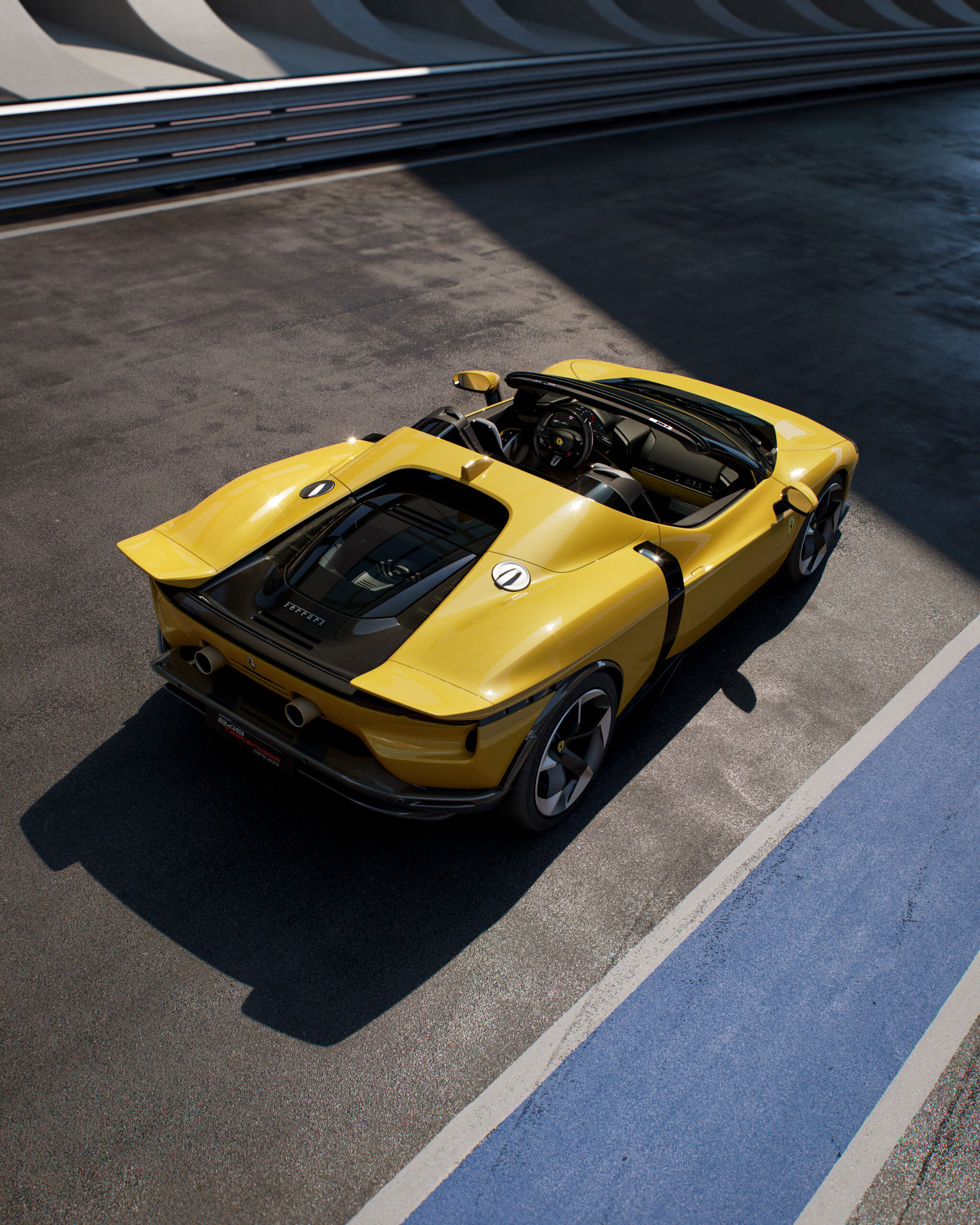
Open-Air Engineering: RHT, Wind Catcher & Cabin Calm
This car is both an authentic coupé and an actual spider. The retractable hard top opens or closes in 14 seconds at up to 45 km/h so that you can flip between moods without a roadside pause.
14-Second Roof, 45 km/h Operation
The compact RHT maintains a cohesive roofline when shut and a pure rear sculpture when open. Packaging preserves luggage space and cooling paths, so there’s minimal compromise to daily usability or thermals.
Patented Wind Stop & Tonneau Bridge
A new wind catcher integrated behind the seats channels high-energy air from the side window area down to the footwell region, reducing upper-cabin swirl for calmer voices and less fatigue. The extended tonneau bridge guides flow to the engine cover and spoiler with the roof closed, aligning downforce with the closed-roof berlinetta’s targets.

Design Language: Sculptural Tech
Ferrari’s Styling Centre under Flavio Manzoni re-imagines the V8 berlinetta spider with sharp, architectural volumes.
Exterior: Doors as Aero Ducts, Twin-Tail Drama
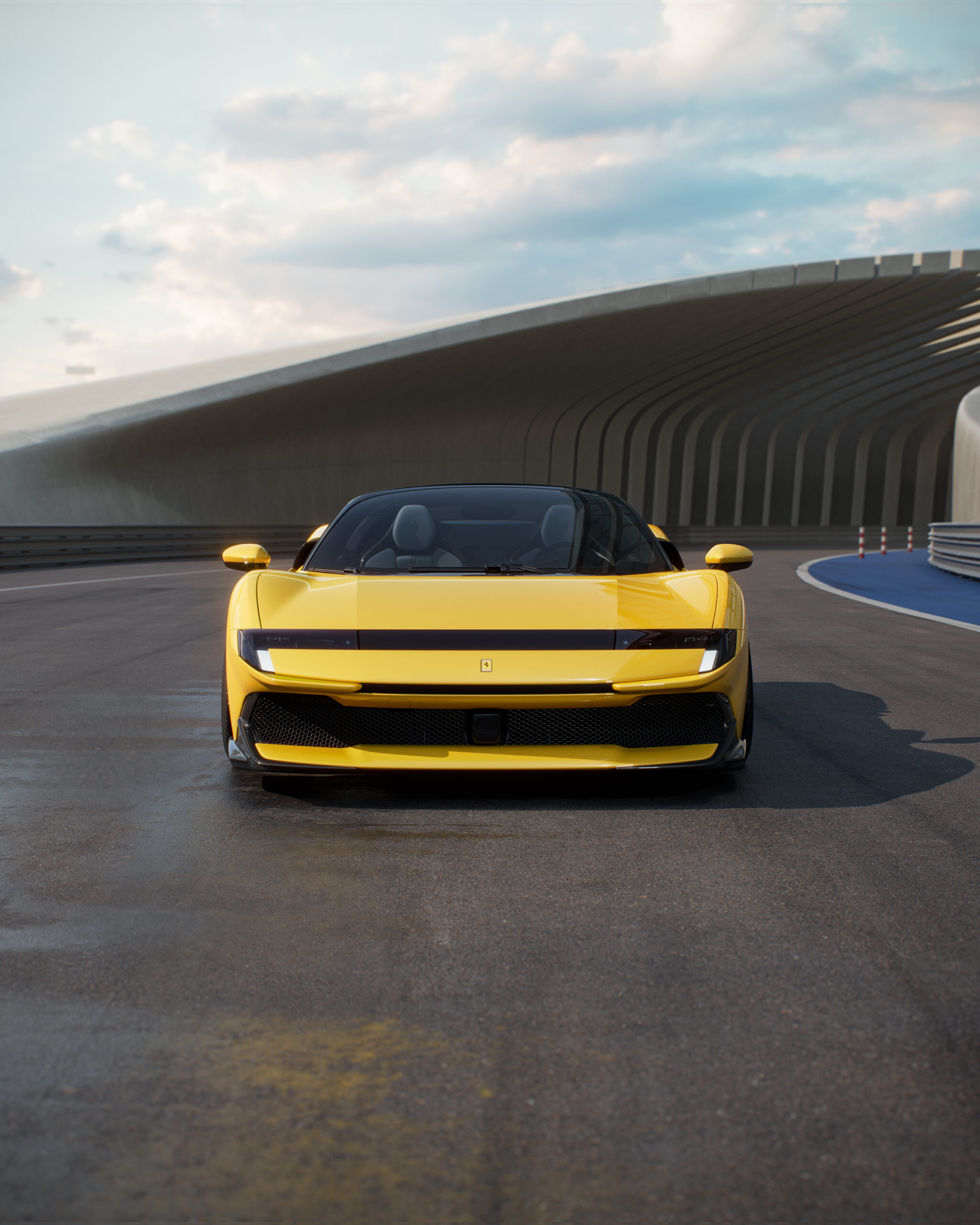
The doors are both sculpture and ductwork: a deep, three-dimensional upper panel feeds the lower intercooler portion. At the same time, a profiled vertical intake wraps into the sill and adds an auxiliary opening. The face channels 1980s Ferrari cues with a full-width bridge linking slim headlights above a technical lower bumper and splitter. Out back, the twin-tail architecture frames an active wing over a central diffuser and round tailpipes. Forged wheels add diamond-cut aero blades to manage wake and heat.
Interior: Sail Motifs, Gate Shifter, HMI
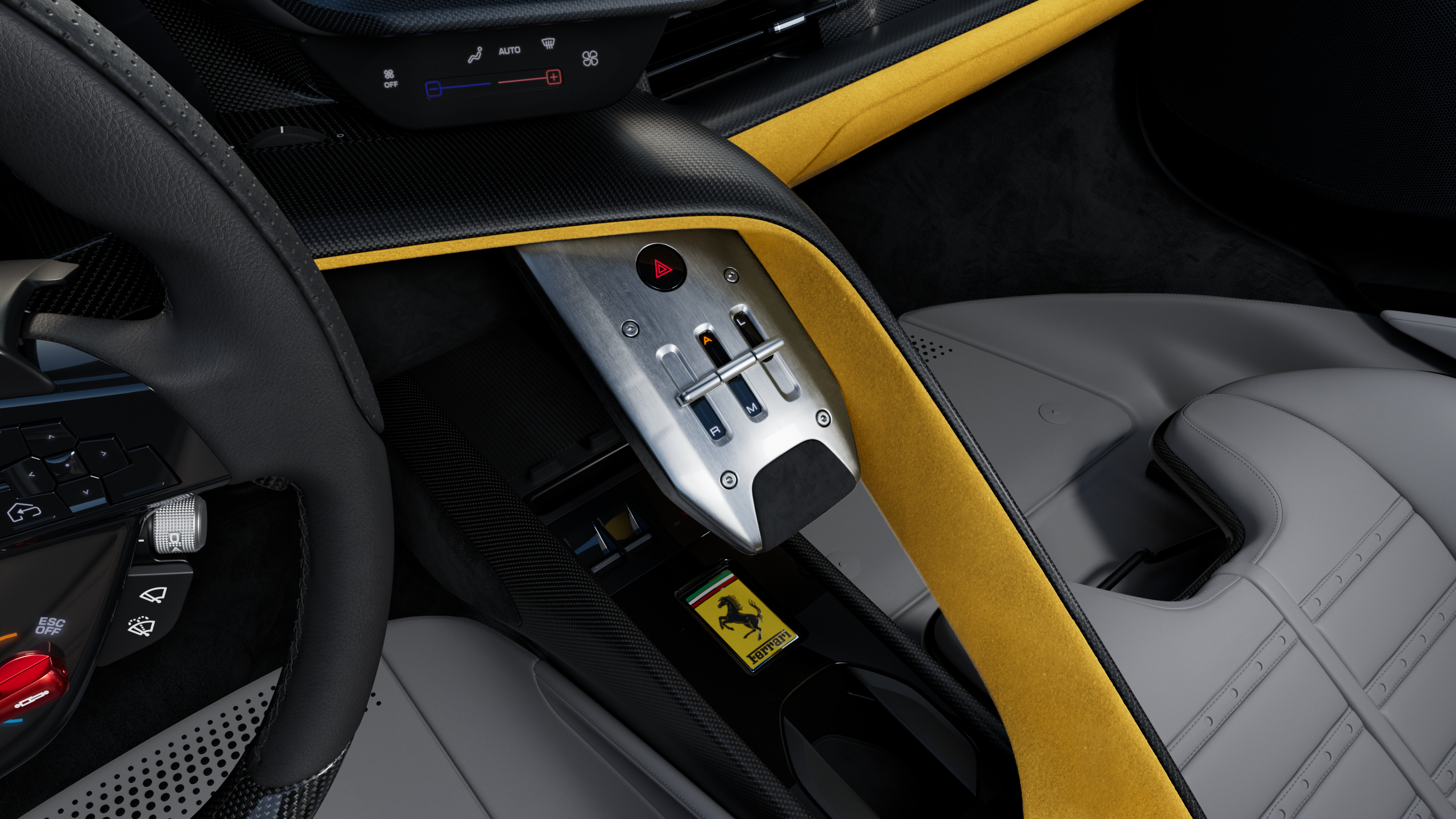
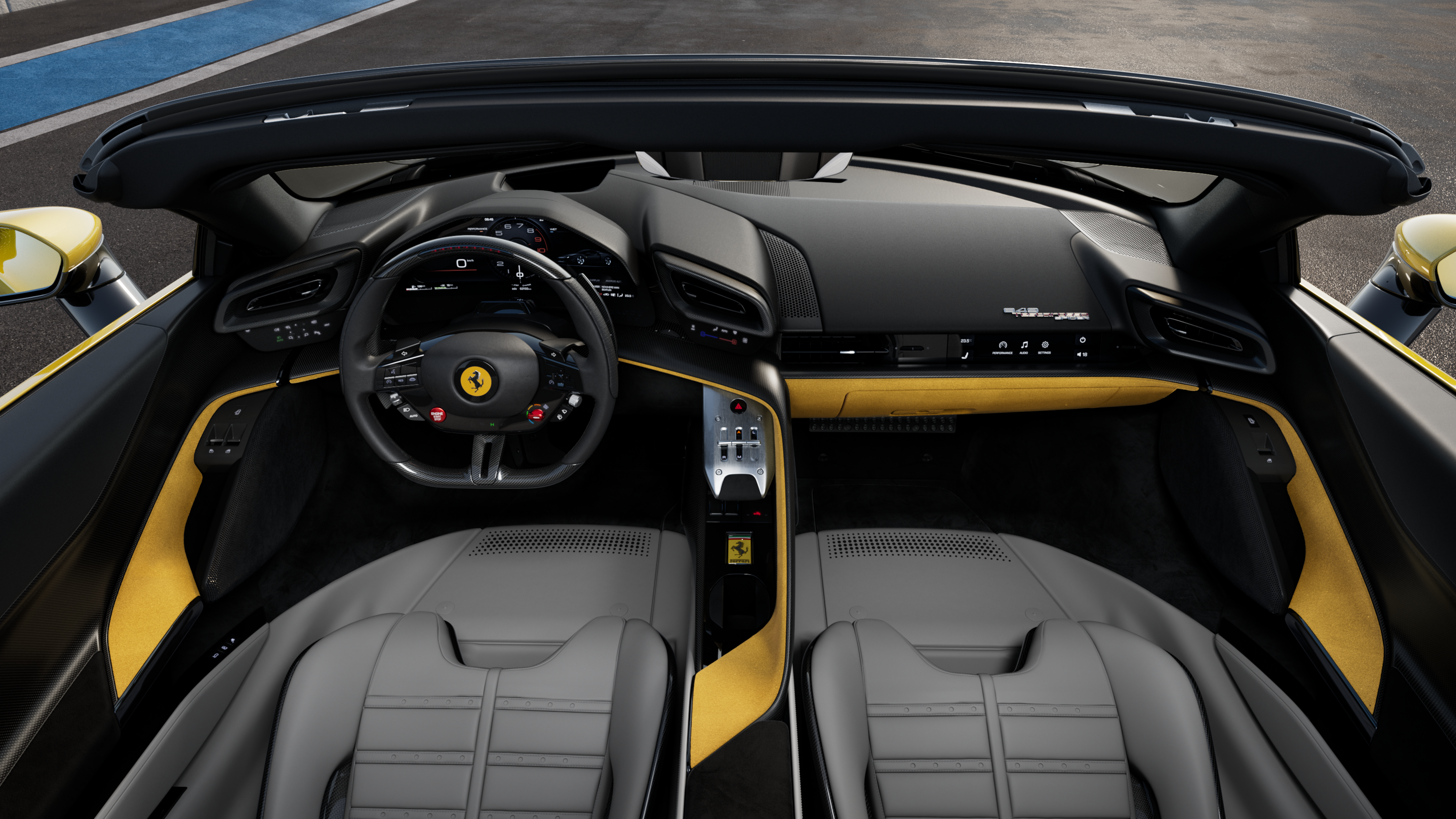
Inside, a horizontal dash with floating “C” vents meets two sail motifs that hold core controls and the F80-inspired, gated gear selector. A redesigned steering wheel returns tactile mechanical buttons—including the iconic Engine Start—while a new HMI simplifies mode changes, including the eManettino for electric driving. Wireless phone charging, Apple CarPlay® and Android Auto® integration, and MyFerrari Connect bring quite modernity to a cockpit built for loud feelings.
Assetto Fiorano: The Track-Focused Spec
Think of this as a factory lap-time package with real depth. The Assetto Fiorano trims about 30 kg using titanium and carbon fiber, swaps in stiffer single-rate Multimatic dampers, and lowers roll gradient by another 10%. Up front, larger flicks and extra vortex generators sharpen balance; at the rear, dual wings replace the twin tails to triple vertical downforce with minimal drag penalty. Pair the lightweight tubular seats (-~18 kg) and optional 20″ carbon-fiber wheels with Michelin Pilot Sport Cup 2 rubber, and you’ve got a compelling track stance. For the first time, you can spec a front lifter and keep Magneride if you prefer mixed-use comfort.
ADAS & Connectivity: Discreet, Helpful, Configurable
Driver assistance stays in the background until needed: Adaptive Cruise Control with Stop & Go, Automatic Emergency Braking with Cyclist Detection, Blind Spot Detection, Lane Keeping Assist, Automatic High Beam, Traffic Sign Recognition, Surround View, Rear Cross Traffic Alert, and driver-fatigue monitoring. All can be adjusted from the cluster so you decide how much help you want.
Personalisation & Materials: New Paints & Trims
Two debuts headline the palette: Rosso Fiammante, a metallic evolution of Rosso Corsa with warm, sun-lit reflections, and Giallo Ambra, a rich, amber-inspired yellow with red undertones. Inside, Giallo Siena Alcantara® pairs beautifully with Giallo Ambra exteriors. Forged wheel designs and finishes vary widely, with aero-conscious geometry across the board.
Ownership: 7-Year Maintenance & Hybrid Warranties
Every new Ferrari comes with a seven-year Genuine Maintenance program, covering regular servicing with factory parts and trained technicians. Hybrid components carry a five-year warranty, extendable via Warranty Extension Hybrid (up to year 8 with a no-cost HV battery replacement if you extend that far). The Power Hybrid program then covers significant powertrain and hybrid components from year 8 to year 16, again including a no-cost HV battery replacement from year 16. For official details on Ferrari ownership programs, see the brand’s site: Ferrari Official.
Key Specs at a Glance
| Category | Highlight |
| Powertrain | Plug-in hybrid: twin-turbo V8 + 3 e-motors |
| Combined Output | 1,050 cv |
| ICE Output | 830 cv @ 7,500 rpm; 842 Nm @ 6,500 rpm |
| Redline | 8,300 rpm |
| Battery | 7.45 kWh Li-ion |
| e-Range | Up to 25 km (eDrive) |
| Drivetrain | e-AWD with RAC-e front, MGU-K rear |
| Transmission | 8-speed dual-clutch F1 |
| Aerodynamics | 415 kg @ 250 km/h; active rear spoiler |
| Dimensions (L/W/H) | 4,718 / 2,304 / 1,186 mm |
| Wheelbase | 2,650 mm |
| Tracks (F/R) | 1,678 / 1,673 mm |
| Dry Weight | 1,660 kg |
| Weight Distribution | 45% F / 55% R |
| Tyres (F/R) | 265/35 R20; 325/30 R20 |
| Brakes (F/R) | 410×223×38 mm; 372×233×34 mm |
| Performance | 0–100 km/h <2.3 s, 0–200 km/h 6.5 s, Vmax >330 km/h |
| Fiorano Lap | 1’18”100 |
| Roof | RHT opens/closes in 14s up to 45 km/h |
Elysium987 Interactive
Ferrari 849 TESTAROSSA SPIDER — FAQ
Copy answers. Share with one tap. Quiz your friends. Spark debate.
Q1 What sets the 849 TESTAROSSA SPIDER apart from the SF90 Spider it replaces?
A: Power jumps by 50 cv to 1,050 cv, downforce rises to 415 kg at 250 km/h, the V8 now makes 830 cv, and electronic controls evolve with FIVE and ABS Evo for crisper, more repeatable braking and traction.
Q2 Is the Spider still practical for daily use?
A: Yes. The 14‑second RHT operates up to 45 km/h, with an eDrive mode for quiet trips of up to 25 km. Additionally, ADAS features can help relieve fatigue without compromising engagement.
Q3 How does the hybrid system improve lap times rather than just straight-line speed?
A: RAC‑e torque vectoring pivots the car into corners, the MGU‑K fills torque gaps, and the FIVE estimator refines slip, yaw, and speed targets so stability and traction systems work with surgical precision.
Q4 What does Assetto Fiorano change?
A: Roughly −30 kg, stiffer Multimatic dampers, more aggressive aero (including dual rear wings that triple downforce), lighter seats (~−18 kg), optional carbon wheels, and tailor‑made Michelin Cup 2 tyres.
| Spec | Standard | Assetto Fiorano |
|---|---|---|
| Mass | — | −≈30 kg |
| Dampers | Standard adaptive | Multimatic (stiffer) |
| Aero | Active rear spoiler | Dual wings, higher DF |
| Seats | — | −≈18 kg |
| Tyres | — | Michelin Cup 2 |
Q5 How is thermal management addressed for track use?
A: Larger radiators (+18% area), 19% bigger intercoolers with better angle, expanded front intakes (+18%), and significantly improved brake cooling (+15% front, +70% rear).
Q6 What makes the sound special in a turbo‑hybrid Ferrari?
A: Revised exhaust geometry in Inconel, calibration that elevates bright harmonic orders in the mid‑range, and shift mapping (inspired by SF90 XX Stradale) that adds dramatic, racing‑style over‑run on upshifts.
Q7 Can I customize the look extensively?
A: Absolutely. New paints (Rosso Fiammante, Giallo Ambra), new interior trim (Giallo Siena Alcantara®), multiple forged wheel designs, and an Assetto Fiorano livery in Bianco Cervino or Rosso Corsa with a graduated double stripe.
Q8 How do the warranties work for the hybrid system?
A: Standard hybrid coverage is 5 years, with optional Warranty Extension Hybrid up to 8 years (including an HV battery replacement at no cost if extended that far). Power Hybrid then extends primary component coverage from year 8 to year 16, again with a no‑cost HV battery replacement from year 16.
What wowed you most?
Anonymous, device‑local results. Vote to reveal live percentages.
Quick Quiz
How fast does the retractable hard top (RHT) open?
Embed this FAQ
Drop this on your blog to spark debate. Attribution appreciated. #Elysium987
Why This Ferrari Matters Now
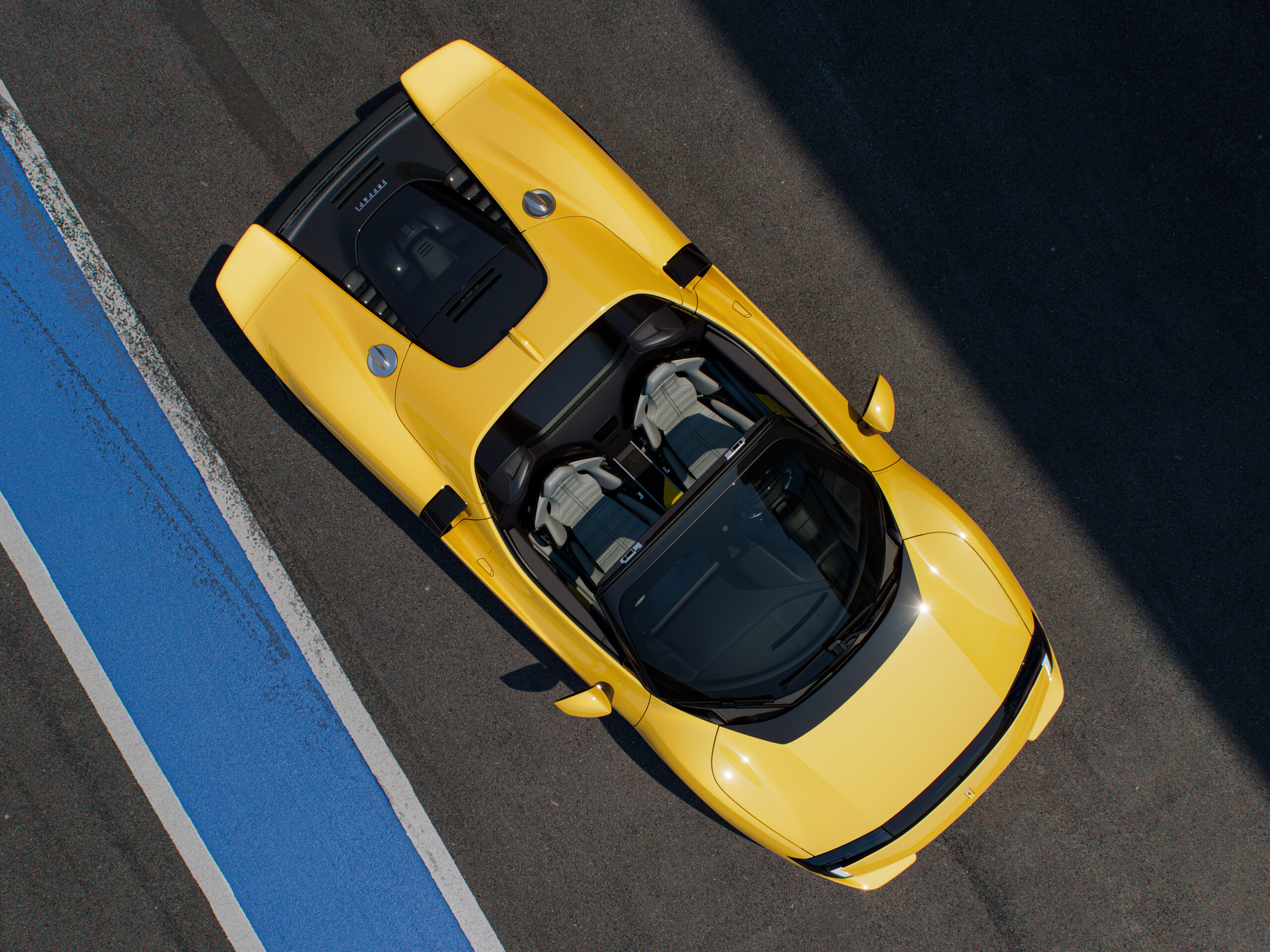
The FERRARI 49 TESTAROSSA SPIDER doesn’t just add power; it integrates motorsport-grade estimation, aero that genuinely works, and a cabin that’s both tactile and tech-savvy. The result is a spider that behaves like a serious coupe on track, then flips into refined open-air touring at a button’s push. It honors a 70-year story by doing what each Testa Rossa has done best: redefining what a fast Ferrari feels like—today.