Elysium
Forget showpiece clocks. La Quête du Temps is a one-meter, museum-grade astronomical automaton that displays time through choreography—the centrepiece of Vacheron Constantin’s 270th. Seven years. 6,293 components. 23 complications. 15 patents. This is a line in the sand for modern high horology.
Executive Snapshot
- What it is: A monumental astronomical clock where a humanistic Astronomer automaton indicates the time, not a decorative gimmick, a true timekeeping complication.
- Development: 7 years, uniting master watchmakers, an automaton, engineers, artisans, and astronomers.
- Numbers: 6,293 mechanical components (including 2,370 for the clock), 1,020 for the habillage; 23 watchmaking complications; 144 automaton gestures; 158 cams; 15 patent applications (7 watchmaking, 8 automaton).
- Début : “Mécaniques d’Art” au Louvre, Sept 17 – Nov 12, 2025.
- Spin-off: A 20-piece Métiers d’Art double-sided wristwatch with Calibre 3670 and four patent applications.
Why it matters (no spin)
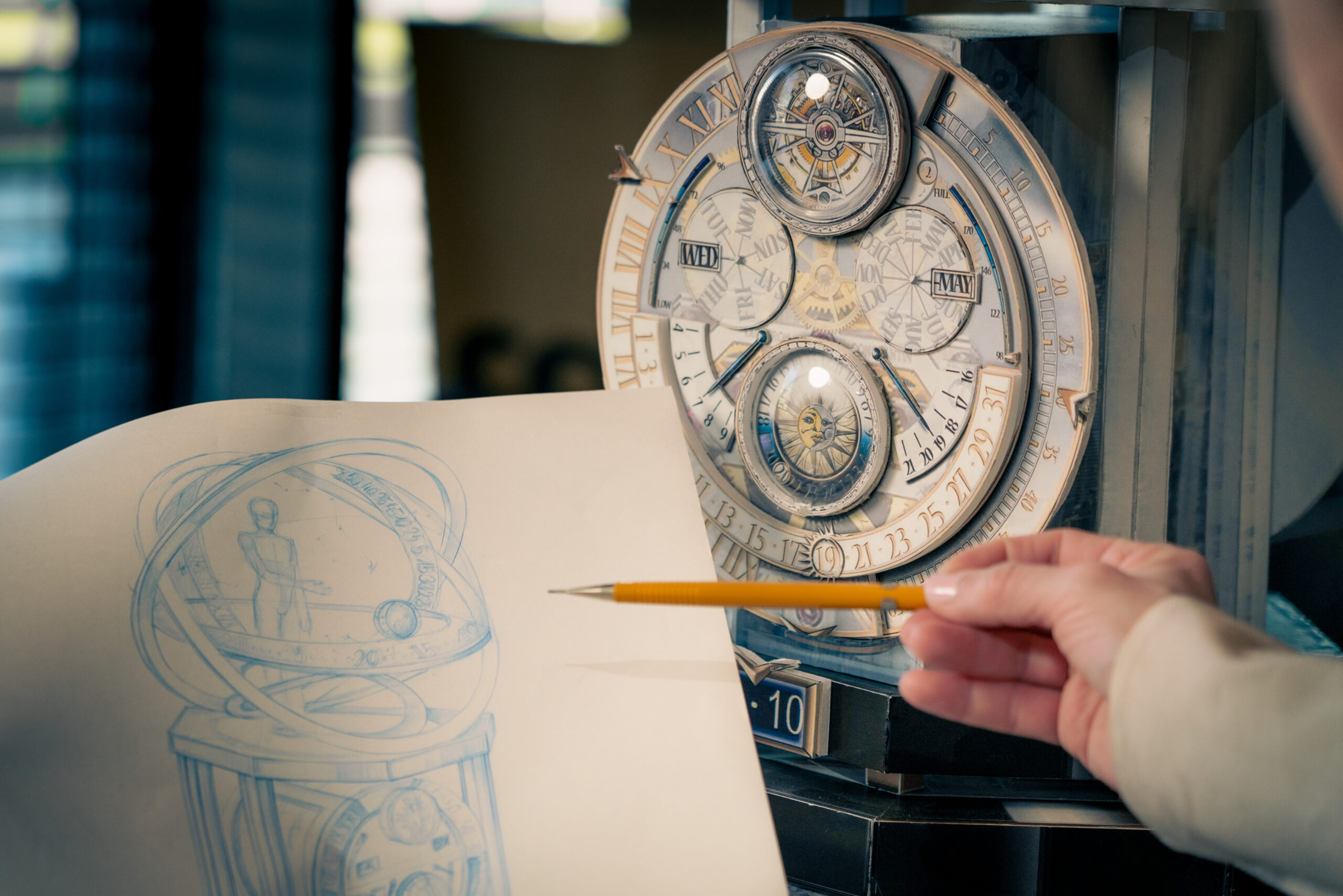
Most grand clocks are static prestige. La Quête du Temps flips the model: the automaton is the display. A mechanical memory bridges civil time to the automaton’s gestures, turning information into theatre. It’s not just impressive—it’s a redefinition of what a complication can be in 2025.
Key Specifications (at a glance)
| Pillar | Details |
| Movement (Clock) | Calibre 9270, manual wind, 15-day power reserve (five barrels), oversized tourbillon (Maltese-Cross cage) |
| Complications (23) | Perpetual calendar (day/month/date/leap year), sunrise & sunset (Geneva latitude), sidereal time, 24-hour day/night, multiple retrograde indications |
| Automaton | 144 gestures driven by 158 cams; head & arm kinematics indicate hours and minutes |
| Music | Integrated mechanical music device (metallophone + wah-wah tubes) with three sequences |
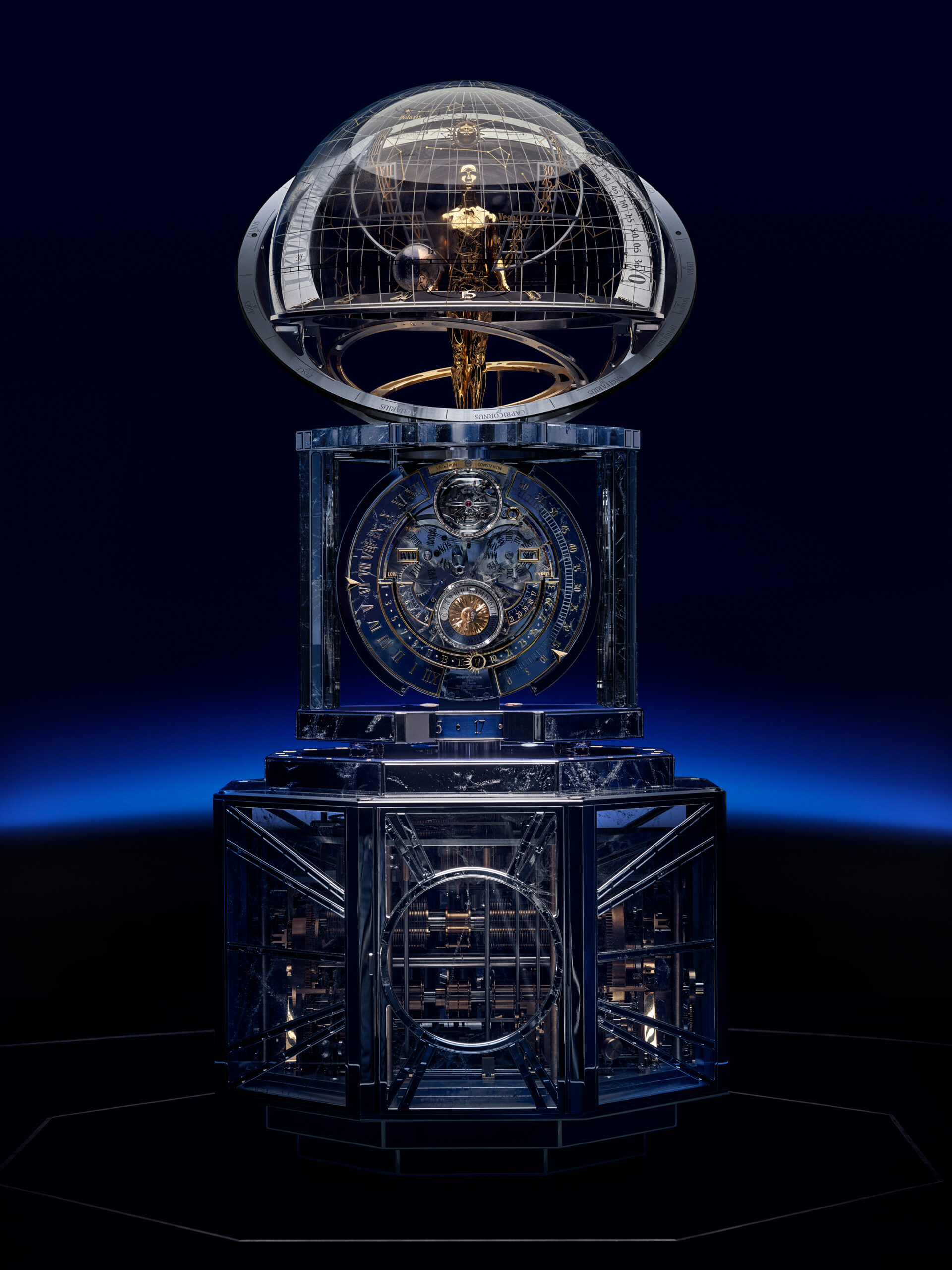
| Architecture | Dome / Clock / Base three-part build; painted celestial vault; 3D precision moon (110-year accuracy) |
| Materials & Métiers | Rock crystal, lapis-lazuli, hard-stone & mother-of-pearl marquetry, grand feu enamel, guilloché, high-relief engraving, diamond setting |
| Scale | Approx. 1.07 m tall; approx. 250 kg |
| Patents | 15 applications total (7 watchmaking, 8 automaton) |
Movement & Kinetics: Brains behind the spectacle
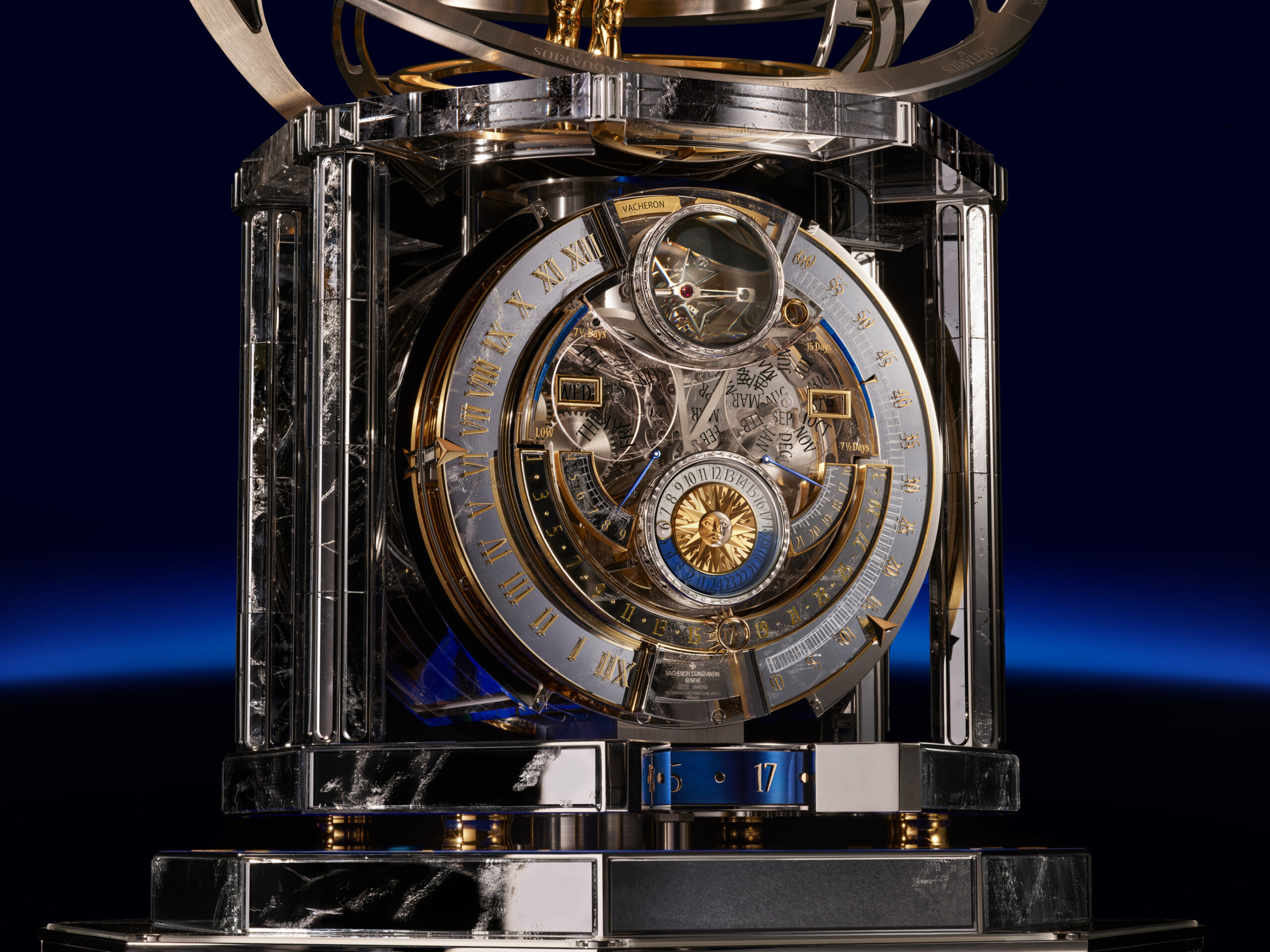
At its core, Calibre 9270 is engineered for endurance and legibility: five barrels deliver a 15-day reserve; the front dial stages a magnified tourbillon at 12 o’clock, a 24-hour sun/moon display, a retrograde date, sunrise and sunset times, and the perpetual calendar. Flip the piece and a Northern-hemisphere sky chart tracks the sidereal day—a precise astronomical read, not just ornamentation.
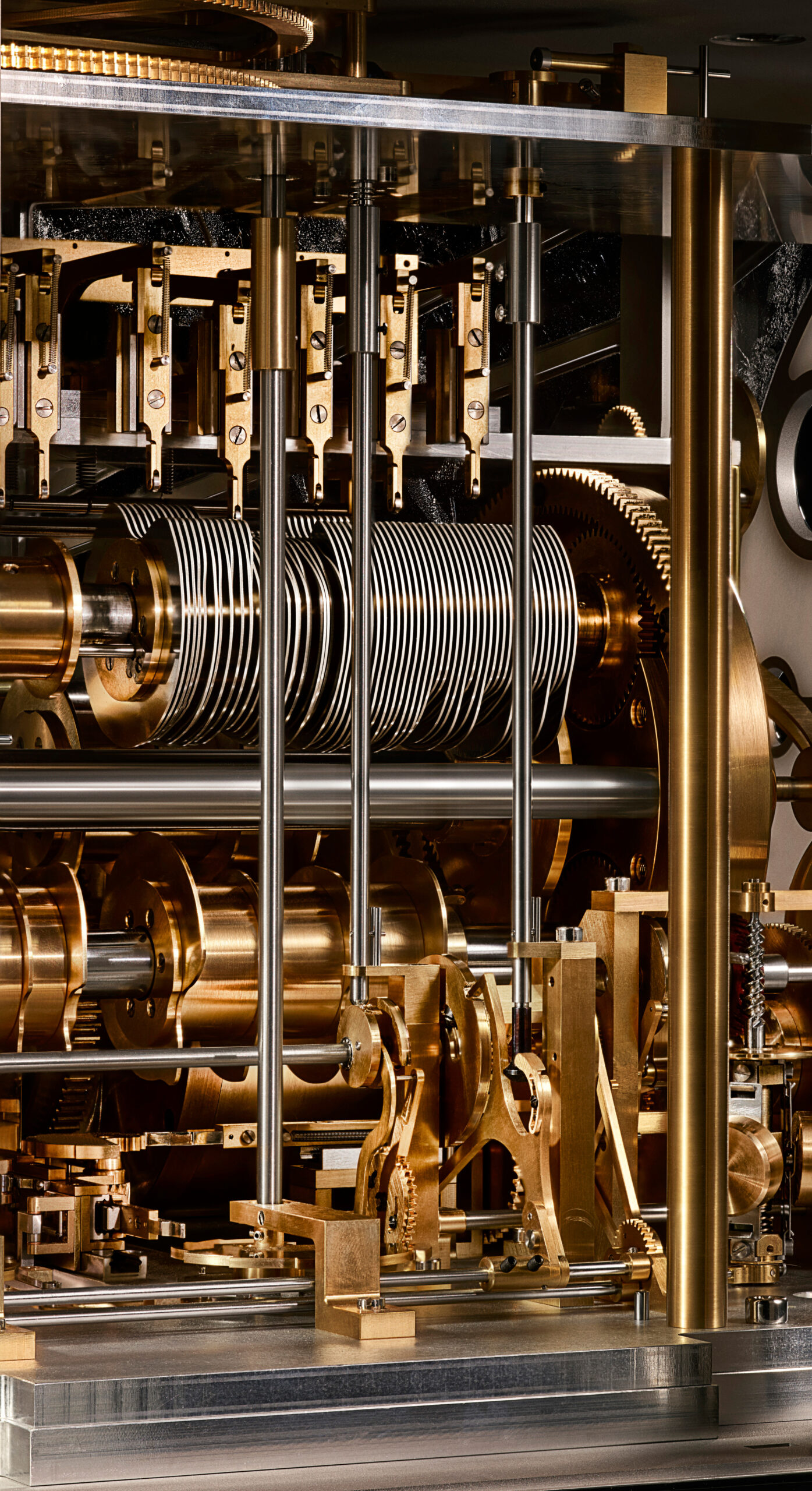
Why this is clever: a mechanical memory captures hour/minute information from the movement and transmits it to the automaton’s cam system. The automaton doesn’t “perform”; it tells time.
The Automaton: Choreography as a Complication
- Natural motion: A 360° carousel with 158 cams delivers 144 distinct gestures across multiple planes (head, shoulders, arms), creating lifelike motion.
- Readable theatre: Hour and minute scales under the dome are intentionally non-sequential, so the gesture path varies—each activation is visually fresh while still precise.
- On demand or scheduled: Trigger the sequence instantly or pre-program up to 24 hours in advance.
- Sound design: The integrated mechanical music system punctuates sequences with a bespoke sonic signature.
Astronomy, Materials, Métiers d’Art
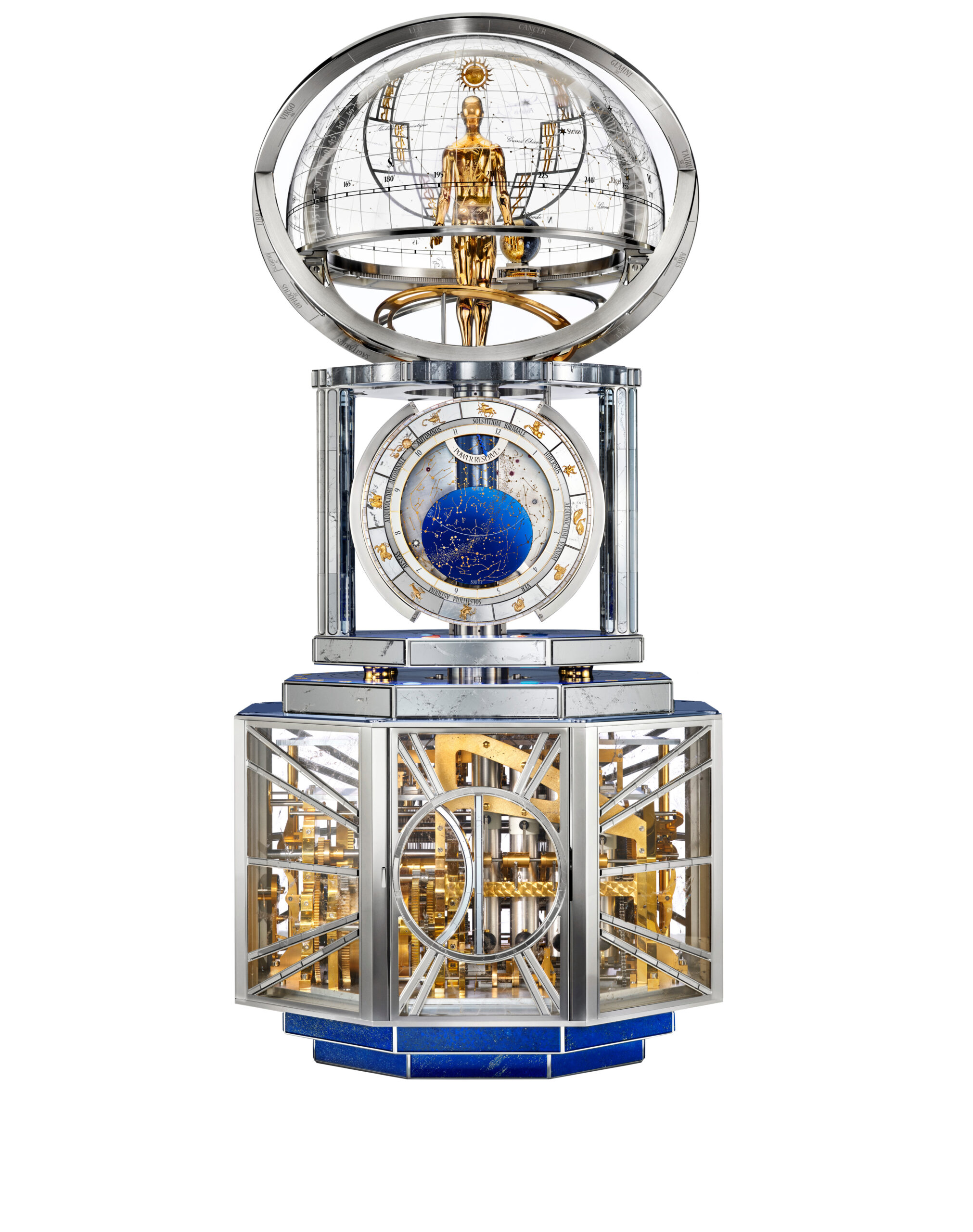
- The Dome: A glass sphere painted by hand with the Geneva sky on Sept 17, 1755—the Maison’s founding date—plus a 3D precision moon (110-year accuracy) and day/night tableau at the Astronomer’s feet.
- The Clock (Front/Back): The front features the tourbillon, day/night, sunrise/sunset, retrograde date, and calendar; the reverse displays a celestial vault that rotates once per sidereal day, accompanied by rings for months, seasons, solstices/equinoxes, and the zodiac.
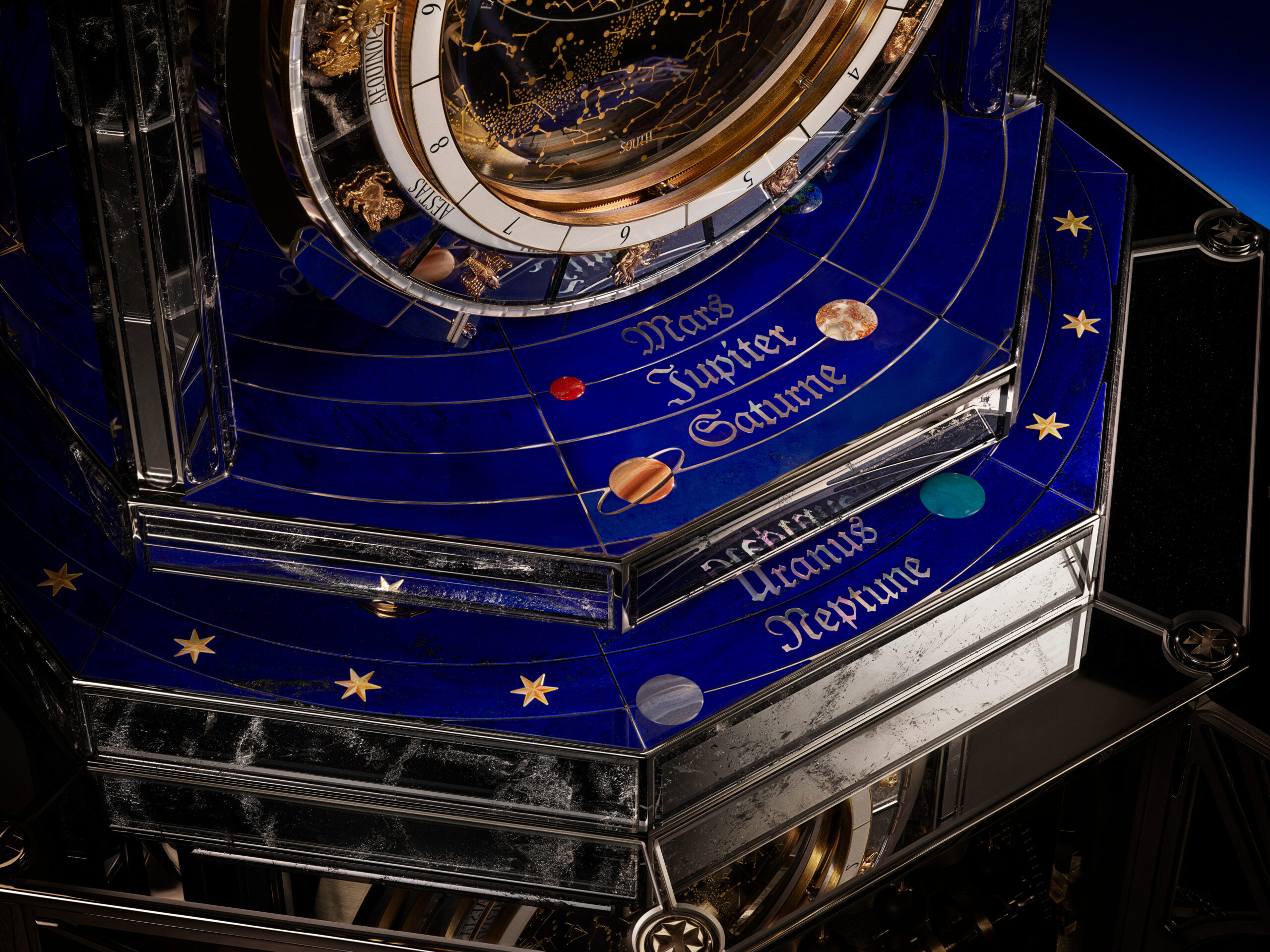
- The Base: Rock crystal cladding reveals the automaton’s mechanism; a lapis-lazuli plinth depicts the solar system with hard-stone cabochons and mother-of-pearl inlays—a transparent mass that keeps a one-meter object visually light.
- Finishing Discipline: Hand bevelling and chamfering are scaled up to architectural components; diamond-set highlights emphasise focal points (tourbillon aperture, 24-hour display).
Design & User Experience: Information design in motion
- Clarity at scale: The dial architecture uses mirrored rock crystal layers and concentric arcs to keep data readable.
- Retrograde logic: Power reserve splits into two sectors for an intuitive 15-day read; retrograde date is driven by a sun-shaped pointer.
- Always upright: Ingenious mounting ensures the sun/moon appliqué and the reverse-side sun indicator remain vertically oriented to the observer.
The Wristwatch Spin-Off (Collector Intelligence)
Métiers d’Art “Tribute to The Quest of Time” translates the concept into a double-sided wristwatch limited to 20 pieces, powered by the new manual Calibre 3670 with four patent applications.
- Front: A sculptural figure indicates time via double-retrograde “arms”, with a 3D precision moon and the age of the moon.
- Back: A real-time sky chart that tracks the sidereal day.
- Positioning: This is the portable chapter of the same narrative—art-level horology with serious technical credibility.
Exhibition & Availability
- Clock: La Quête du Temps is the centrepiece of the “Mécaniques d’Art” exhibition at the Louvre, Paris, Sept 17 – Nov 12, 2025.
- Wristwatch: Métiers d’Art “Tribute to The Quest of Time” is limited to 20 pieces, allocation via Vacheron Constantin.

Verdict (tell-it-like-it-is)
- For: Cultural institutions, mécaniques d’art patrons, UHNW collectors who buy provenance + narrative + engineering scarcity.
- Not for: Minimalists or anyone allergic to spectacles.
- Bottom line: La Quête du Temps reframes a clock as a living astronomical instrument—the most convincing 270th-anniversary statement in the category. Zero filler, all substance.

FAQs
What is La Quête du Temps?
A monumental astronomical automaton clock by Vacheron Constantin that indicates time via an automaton’s gestures, built over seven years with 6,293 components and 23 complications.
Why are the hour/minute scales non-sequential?
To ensure each activation produces a distinct gesture path, so time reading is functional and visually engaging.
What’s unique about the moon display?
A 3D precision moon with 110-year accuracy and a retrograde function powered by its own barrel.
Is there a wristwatch version?
Yes—Métiers d’Art “Tribute to The Quest of Time”, 20 pieces, double-sided display with Calibre 3670 and four patent applications.
Interview: The Vision Behind La Quête du Temps
An insider conversation on why Vacheron Constantin set out to create an automaton that tells time—uniting art, science, and horology.
Q: How did you come to the idea of challenging yourselves to create an automaton that tells the time?
A: Our watchmakers, designers, artisans, and conceptors are accustomed to pushing beyond limits while remaining true to the Maison’s spirit. Historically, automatons were standalone or decorative mechanisms. We set out to revisit both worlds—automata and clockmaking—and dreamt of a figure that would indicate hours and minutes as part of the timekeeping function itself.
Rooted in the 18th century’s Age of Enlightenment—when scientific devices were both sophisticated and beautiful—we chose a human figure for philosophical reasons that align with the Maison’s identity.
Q: What enabled the team to transcend known limits over seven years?
A: The “magic ingredient” was the human adventure—assembling equally passionate, talented people willing to dream together, challenge each other, and keep a sense of play. Creativity was continuous: asking questions, pushing further, and sustaining momentum through rigorous craft and shared purpose.
Q: What were the main technical challenges?
A: Integrating the automaton with timekeeping demanded a mechanical memory to transmit civil time from the clock to the automaton. Driving 144 gestures required a carousel with 158 cams. To add a musical dimension, we invented two kinds of mechanical “music box.” The clock’s scale also challenged tolerances—e.g., an oversized tourbillon (balance wheel Ø 16.8 mm excl. screws; Maltese Cross Ø 28 mm; fixing bar 43.3 mm) with virtually zero margin for error.
Q: What about the challenges of the habillage and decoration?
A: Sourcing large, flawless rock crystal for the base took two years; then came cutting, machining, hand-finishing, and integration. The celestial vault on the glass dome was painted entirely freehand, in reverse on the inside surface, with tiny brushes—no templates—demanding absolute precision.
Q: How does the philosophical dimension appear concretely in the piece?
A: The design encodes ideas about beauty and infinity—for example, the number eight (eight planets / symbol of infinity) appears throughout: an octagonal base and columns in rock crystal, and the automaton poised on an eight-pointed star. The work invites each viewer’s own interpretation while remaining faithful to the Maison’s codes.

Technical Data — La Quête du Temps
Comprehensive specifications covering the clock movement, automaton, habillage, patents, complications, systems, and materials.
1) Clock Movement
| Calibre | 9270 |
|---|---|
| Diameter | 223 mm |
| Thickness | 262 mm |
| Jewels | 148 |
| Frequency | 18,000 v/h |
| Power reserve | 15 days |
| Energy | 5 barrels (clock movement) + 1 barrel (retrograde moon function) |
| Components | 2,370 |
| Tourbillon dimensions |
Balance wheel Ø 18.8 mm (incl. screws) / 16.8 mm (excl. screws); Maltese Cross Ø 28 mm; Fixing bar length 43.3 mm |
2) Automaton
| Energy source | 1 barrel, manually wound by a handle |
|---|---|
| Carousels | 1 revolving carousel with 3 shafts carrying cams that animate the automaton |
| Choreography | On demand or pre-programmable up to 24 hours in advance |
| ‘The Astronomer’ Automaton | Cast bronze, gilded with 18k 3N gold, set with 122 brilliant-cut diamonds; 379 components |
| Transmission | Transfer of civil time from the clock via 2 vertical columns and a mechanical memory |
| Mechanical memory | Captures civil time info and transfers it to the automaton |
| Musical sequences | 2 instruments: 1 metallophone + 4 wah-wah tubes; 534 components |
| Total components (automaton system) | 3,923 |
| Total cams |
158 total: Alarm 11; Presentation of the Moon 11; Minutes 60; Hours 60; Bell cam 1; Wah-wah dampeners 4; Snails (mechanical memory) 2; Snails (clock output) 2; Function stops & releases 6; Alarm reinitialising 1 |
3) Habillage & Other Items
| Components | 1,020 |
|---|---|
| Dimensions | 1,070 × 503 mm |
| Weight | Approx. 250 kg |
List of Patents Applied For
- Retrograde moon-phase display mechanism — 3D moon with integrated barrel for return-to-zero and permanent gearing tension
- Movement with two mobile drive devices & safety device — time-setting safety (lock/unlock behavior)
- Mechanism governing operation of the clock — dual gear trains with priority to time display
- Drive device for a mobile display with two actuating kinematics
- Rapid date correction in one-day steps
- Actuating device with timer mechanism — prevents restart until cycle completion
- Actuating device with power-reserve indicator — coaxial display; activation reduces autonomy
- Retrograde date display mechanism — end-of-month recall via finger on date wheel
- Two-sector power-reserve display — dual coaxial cams; offset concentric sector (2 × 7.5 days)
- Mechanical memory system — non-invasive hour/minute info recording and remote storage
- Control system for an automaton — “revolver” mechanism with multiple cam shafts (some sliding)
- Barrel with two outputs — powers shaft rotation or carousel rotation
- Kinematics of the automaton’s head — naturalistic head movement
- Articulation system for the automaton — differential to combine two movements in one limb
- Control of resting position of sensor-probes — different rests for uni/bidirectional movements
- Wah-wah musical tone — flap and striking mechanism for wave-like sound
Watchmaking Complications & Systems
Civil Time Indications (4)
- Additional 24-hour rotating hour & minute display
- 3D retrograde hours & minutes indicated by the automaton
- One-minute tourbillon
- Day-Night indication
Perpetual Calendar (6)
- Gregorian perpetual calendar (day)
- Month (front dial)
- Month (back dial)
- Retrograde date (month display)
- Leap year & four-year cycle
- Calendar coherence across displays
Moon Indications (3)
- Precision moon-phase (110 years without correction)
- Age of the moon
- Rotating 3D moon with retrograde function & internal barrel
Astronomical Indications (5)
- Sunrise time (Geneva latitude)
- Sunset time (Geneva latitude)
- Celestial vault (Northern Hemisphere)
- Sidereal time
- Seasons, solstices & equinoxes
Additional Functions (5)
- Astrological zodiac signs
- Alarm to activate automaton
- Two-sector retrograde power reserve display
- Power reserve by hand on back dial
- Power reserve for rapid correction function
Additional Systems (9)
- Adjustable magnetic brake for daylight saving
- Security preventing reverse alarm setting
- Rapid one-day correction with dedicated barrel
- PR indication for rapid correction function
- Double safety device for time setting
- Internal barrel powering 3D Moon (inside the Moon)
- Adjustable magnetic brake controlling Moon’s retrograde jump
- Six safety devices for transport
- Hour & minute indicators descending by gravity on the clock
Automaton Systems
- 360° rotating carousel driving axes & cams for all choreography
- Lateral acquisition of civil time info from the clock; stored and transmitted to automaton
- Alarm function for automaton start: rod engages at desired time
- Automaton PR hand on right of base (front view)
- Manual winding socket for automaton barrel on right of base (front view)
- Cam reset-to-zero to ensure correct information display
- Figure animated by tungsten cables linked to sensor-probes driven by cams
- Internal mechanism enables humanoid choreography of limbs
- Ball-and-socket shoulder with articulated cover concealing mechanisms during motion
- Musical sequences via metallophone & wah-wah tubes, controlled by gear train driven by automaton barrel
Habillage, Materials, Decoration
Base (Octagonal)
- Plinths: Two octagonal structures in stainless steel (matt anthracite base)
- Lower plinth: Rock-crystal marquetry with inclusions
- Upper plinth: Old-mine lapis-lazuli marquetry
- Automaton cabinet: Stainless-steel frame, rock-crystal marquetry; cloudy rock-crystal panels; sunburst motif; decorative steel elements set with rock crystal, quartzite, lapis lazuli; flat top with eight beveled mirror panels
- Octagonal connecting plinth: Rock-crystal marquetry sides with inclusions; lapis-lazuli top; cabochons of crazy lace agate, turquoise, striped chalcedony; mother-of-pearl planet names; two-tone mother-of-pearl 6-point stars
- Base–Clock connection: Two stainless-steel feet gilded with 18K 3N yellow gold
Movement Cabinet
- Octagonal plinth with automaton alarm
- Rock-crystal marquetry sides with inclusions; lapis-lazuli top with cabochons (silver obsidian, grey agate, azurite, red jasper)
- Mother-of-pearl planet names; two-tone mother-of-pearl 6-point stars
- Revolving 24-hour display in midnight-blue lacquer; applied hour numerals in 18K 3N gold
Clock Cabinet
- Four octagonal stainless-steel columns with rock-crystal marquetry
- Flat top: eight rock-crystal sections under automaton’s feet; tiger’s-eye (day) and bull’s-eye (night) marquetry
- Central mineral-glass disc: transparent (day), blue lacquer (night)
Clock Displays — Front Dial
- Two curved sections for hours & minutes; rock-crystal sectors; gold applied hour numerals
- Perpetual calendar apertures (day/month/leap year); two-sector PR with moonstones & lapis (white→blue gradient)
- Sunrise & sunset displays in rock crystal; applied black-metal hour markers
- 31-day retrograde date (rock-crystal set; 18K yellow-gold applied numerals)
- Tourbillon with magnifier; 24-hour day-night display; hand-engraved sun-moon motif; guilloché sunrays
- 24-hour ring with white→blue lacquer gradient
- Bezels set with 100 baguette-cut diamonds (≈11.6 ct) around day/night & tourbillon
- Hands/Indicators: Retrograde H/M and PR in brass; 31-day date indicator in 18K yellow gold (sun-shaped, hand-engraved); sunrise/sunset hands in blued steel
Clock Displays — Reverse Dial
- Peripheral ring set with baguette-cut moonstones
- Zodiac ring: 12 bevelled rock-crystal sections with 12 hand-engraved gold zodiac appliqués
- Enamel rings for seasons, solstices & equinoxes; enamel months ring
- Celestial vault: mineral-glass sky chart, engraved & gold-inked; blue-lacquered ellipse
- Engraved/inked power-reserve display
- Hands/Indicators: Hand-engraved 18K yellow-gold sun indicator (months, solstices, zodiac); blued-steel serpentine PR hand
Astronomer’s Dome
- Armillary circles: Stainless-steel outer ring (circular satin finish, polished chamfers); outer circle engraved with astronomical zodiac signs; two moon-drive circles (SS, chamfered)
- Semi-circle: Stainless-steel support for celestial vault dome (matching finishes)
- Exterior circle: Inclined to galactic circle vs. ecliptic (67°), stainless steel (matching finishes)
- Dome: One-piece mineral-glass sphere, cut 4 cm below widest diameter; vault replicates Geneva sky on 17 Sept 1755; constellations & meridians painted freehand on inside (astronomical style; major star names; visible that day: Aries, Taurus, Gemini, Cancer, Leo, Virgo, Libra; plus Ursa Major/Minor, Orion)
- Retrograde moon display: Stainless-steel structure (satin); applied gold moon-phase; 3D moon in two layers with internal barrel and retrograde function
- Hour & Minute scales: Curved, openworked titanium; applied gold leaf indices; hours in Roman numerals, minutes in Arabic — arranged in random order
- Sun appliqué: Hand-engraved
- Automaton figure: Cast bronze (8 parts), yellow-gold plated, articulated in 5 positions; body hand-engraved with constellations; set with 122 brilliant-cut diamonds (≈0.35 ct)